NVIDIA DLSS 5: AI Rendering and the Future Visual Feel of Games
DLSS 5 is not only about performance. It points toward a future where AI participates in how real-time game worlds look, feel, and are experienced.
DLSS — Deep Learning Super Sampling qisqartmasi. Oddiy qilib aytganda, bu NVIDIA’ning sun’iy intellekt yordamida o’yin tasvirini yuqoriroq aniqlikka ko’tarish va ishlash samaradorligini yaxshilash texnologiyasi.
 OFF
OFF

Image comparison source: NVIDIA. Drag to compare.
When NVIDIA revealed DLSS 5 at GTC 2026 in March, what interested me most was not only performance. It was the possibility that AI rendering could change how games handle lighting, materials, and atmosphere.
GTC — NVIDIA’ning sun’iy intellekt, tezlashtirilgan hisoblash, grafika va real vaqt rejimidagi rendering texnologiyalariga bag’ishlangan yirik developer konferensiyasi. 2026-yilgi GTC 16–19-mart kunlari AQShning Kaliforniya shtati, San Jose shahrida bo’lib o’tdi.
DLSS has usually been discussed around performance: higher frame rates, upscaling, frame generation, and smoother gameplay. Those things matter, but DLSS 5 feels like it is moving into a different space. It is not only about making games run faster. It is also about how games look, feel, and how close real-time graphics can move toward a more cinematic and natural image.
According to NVIDIA, DLSS 5 uses a real-time neural rendering model to improve visual fidelity, lighting, and materials while staying grounded in the original 3D scene. That is what makes it interesting to me.
The Visual Problem with Modern Games
I do not play as many games these days unless something truly unique comes out — games like The Last of Us, Death Stranding, or God of War. What holds me back is not only the lack of originality or the constant stream of sequels, remasters, and copy-paste releases. It is also the visual feel of many modern games.
Even with all the progress in graphics, many game worlds still carry an artificial “3D look.” Materials can be technically accurate but still feel too sharp, too clean, or too obvious. Sometimes a wall looks like “a texture,” a face looks like “a shader,” and a scene feels like a collection of beautiful assets rather than one believable world.
This is where DLSS 5 becomes more than a performance feature and starts to feel like a visual tool.
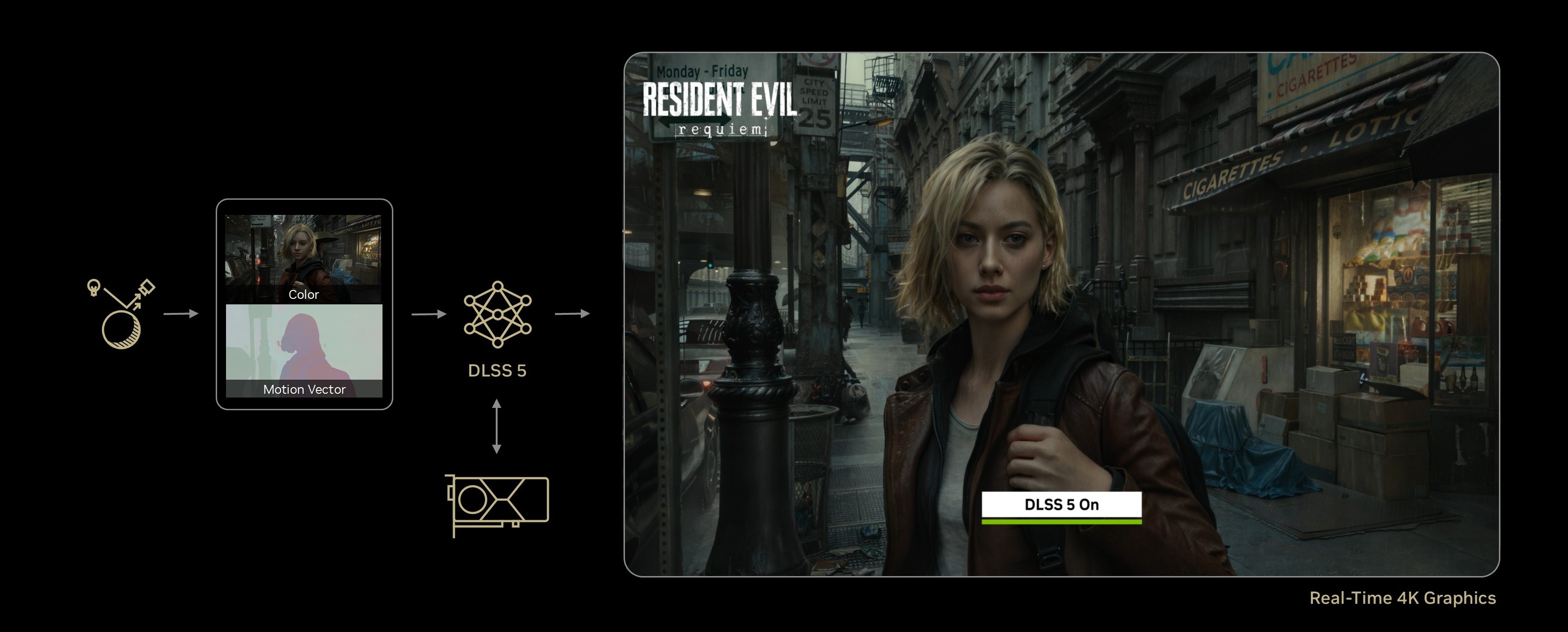 DLSS 5 pipeline diagram source: NVIDIA.
NVIDIA's diagram presents DLSS 5 as a neural rendering layer between the game's original 3D scene and the final image. The engine first draws the scene, then provides DLSS 5 with a color frame and motion vector data. DLSS 5 processes that information through an AI model on RTX hardware and outputs the final real-time 4K image. This is important because DLSS 5 is not only scaling resolution; it is participating in how the final image is reconstructed, stabilized, and visually enhanced.
More Than Performance
To me, the most exciting part is not simply photorealism. Games do not always need to look like real life. What matters is whether the technology can improve lighting harmony, material integration, atmosphere, depth, and the overall mood of a scene.
Lighting is what connects everything together. It makes objects feel like they belong in the same space. When lighting and materials feel natural, a game world becomes more immersive and less technical.
Valid Concerns
Of course, there are valid concerns. Some comparisons show altered faces, and in some cases textures or metallic surfaces may look better with DLSS off. That matters because game visuals are not only about looking “better.” They are about artistic intent.
A smoother face is not always better.
A shinier material is not always better.
A more cinematic image is not always more faithful to the game.
This is where artist control becomes critical. If developers can control the intensity, masking, color grading, and where the neural enhancement is applied, DLSS 5 could become a powerful visual tool. But if it becomes a simple “make it look better” button, it could create a new kind of artificial look — not the old 3D look, but an AI-polished one.
A Tool for Art Direction
What interests me most is the possibility of using this type of neural rendering more intentionally during production, not only as a final visual layer. Artists and developers could use it to support the game's mood, lighting direction, and material feel while still protecting the original art direction.
For me, DLSS 5 is exciting because it changes the conversation. It is not only about fake frames, upscaling, or performance anymore. It points toward a future where AI can help real-time graphics feel less technical and more visually alive.
The real value of DLSS 5 will depend on whether it enhances immersion in a way that supports, rather than overrides, artistic intent.
DLSS 5 should not replace art direction. It should help games feel closer to the worlds their artists imagined.
For now, DLSS 5 is still under development, and it is too early to judge its full potential. What we have seen so far is not the final explosion, but the spark is real. If NVIDIA and game developers can balance neural rendering with artistic control, DLSS 5 could become more than a performance feature — it could become one of the technologies that reshapes how real-time worlds are seen and felt.
Source
Written by bek · April 28, 2026