Review: The Wild Robot
DreamWorks delivers a powerful reminder that animation can still feel fresh, emotional, and visually authored — balancing technology, nature, and morality through stunning animation and thoughtful storytelling.
Spoilers in the Hall!
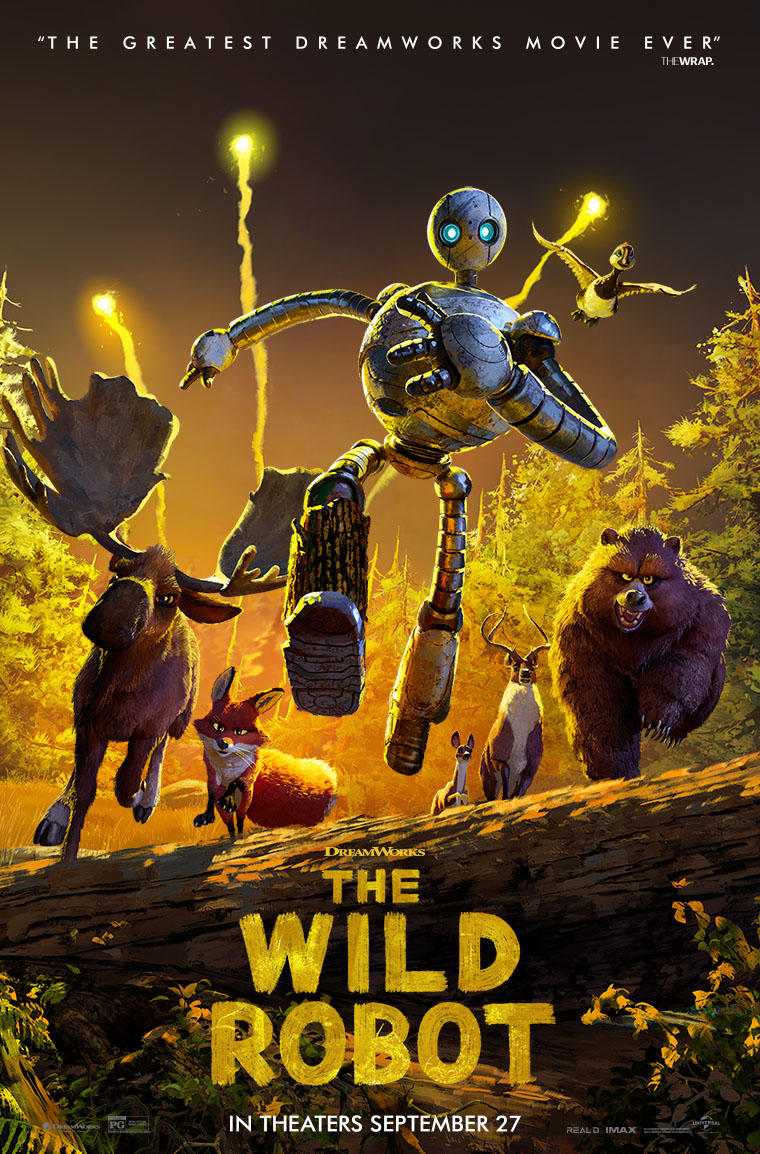
The Wild Robot starts with the quiet charm of an indie animation — intimate, unusual, and visually handcrafted — before gradually expanding into the scale, momentum, and emotional force of a major studio film. At the center of the story is ROZZUM Unit 7134, or ROZ, as it chooses to call itself: the lone survivor of a cargo ship crash and a robot originally designed to assist humans.
Built by Universal Dynamics — hmm, "Dynamics" and Boston… nope, doesn't ring a bell — ROZ has the practical charm of a futuristic service robot. Its rounded body, spherical head, telescopic limbs, and hidden tools reminded me of GizmoDuck and other classic cartoon utility robots, suggesting that ROZ may carry some visual DNA from earlier friendly machine characters. The glowing lines across its body add another layer of personality, turning mechanical seams into emotional indicators. ROZ is not designed to look human, but the film slowly teaches us how to read it emotionally.
The strongest visual idea in the film is the contrast between ROZ and the natural world. ROZ's body is smooth, metallic, and engineered, while the animals are rendered with a brushy, illustrative texture that feels closer to old fairy-tale drawings than pure realism. Fink, the fox, is especially striking: his saturated orange fur feels rough, warm, and alive against ROZ's clean mechanical surface. This contrast makes every interaction between them feel like a meeting between two visual languages.
Set in a maritime forest, the film presents nature as lively, funny, and competitive. What I appreciated is that the animals are not treated as simple symbols of good or evil. In the Russian folklore I grew up with, animals often carry clearer moral roles — the fox, for example, is usually cunning, deceptive, and often female-coded. Here, Fink still carries the sly fox tradition, but the story gives him more emotional range. He is selfish, clever, funny, and eventually capable of care.
One of the film's smartest choices is that the animals do not immediately speak in human language. At first, ROZ observes their sounds, behaviors, and patterns. Over time, it decodes their communication into English for the audience. This is more than a convenient storytelling device; it places us inside ROZ's learning process. We do not simply understand the animals because the movie wants us to. We understand them because ROZ learns to understand them.
One part that felt incomplete to me is the survival solution near the later part of the story. When the animals find shelter in ROZ's home, the film addresses protection but does not fully explore food or long-term sustainability. It would have been interesting to see ROZ develop a system that helps different species survive together without erasing the natural balance of the forest. That could have deepened the film's larger theme: coexistence shaped by intelligence, adaptation, and care.
Based on Peter Brown's novel, The Wild Robot succeeds because it balances technology and nature without reducing either side to a simple message. It is accessible for younger audiences, but mature enough to invite deeper readings about parenthood, survival, community, and artificial intelligence. DreamWorks delivers a film that feels emotionally sincere, visually authored, and thoughtfully designed — a reminder that strong storytelling is not just about technical polish, but about how design, character, and meaning work together.
Experience source
Where to experience it
The review is only my reading of the work. To see it in full color, experience the original through the source.
Some links may be affiliate links. If you buy, rent, or read through them, I may earn a small commission at no extra cost to you.
Written by bek · November 4, 2025